---
title: "Durable knowledge"
source: "https://example.com"
tags: [research, local-first]
---

# Durable knowledge

Readable. Searchable. Yours.
Open source · user-owned knowledge
SourceBraid Weave the web into Markdown.
Turn articles, papers, PDFs, wikis, Gists, and feeds into clean, durable Markdown inside your own private GitHub repository.
- MIT licensed
- No hosted content service
- Your Git history
arXivPDFWordPressWiki
Bookmarks remember where. SourceBraid preserves what matters — structure, metadata, images, and the source itself.
One durable pipeline
From open tab to usable knowledge.
Capture clients choose the strongest available source, prepare it, and commit the result directly to the repository you control.
Capture
Start from Chrome or the iOS share sheet. Add tags and your own notes before anything is written.
Prepare
Use source-specific adapters, normalize links, preserve metadata, and keep relevant images beside the document.
Weave
Commit Markdown and assets to GitHub, then search them locally from ChatGPT or Codex without surrendering ownership.
Source-aware by design
Clean input creates useful archives.
SourceBraid does not treat every page as generic HTML. It follows an ordered adapter chain and uses the richest trustworthy format first.
Full papers, not abstract bookmarks
SourceBraid prefers arXiv HTML, preserving sections, formulas, citations, figures, and paper metadata. PDF conversion is the fallback.
Tables, OCR, and figures included
Original PDFs stay with the archive while Docling turns reading order, tables, OCR text, and extracted figures into portable Markdown.
Structured content before page chrome
The WordPress REST API is used when available, so navigation, banners, and unrelated layout do not pollute the saved article.
A best-source adapter chain
Native Markdown, wikis, Gists, feeds, and dedicated publishing APIs take priority before a careful DOM fallback is used.
arXiv HTML → Azure DevOps Wiki → GitHub Gist→ Native Markdown → WordPress REST→ feeds → clean DOM fallback
Local-first architecture
Your archive is the product.
SourceBraid has no central content store. Markdown and Git history remain the source of truth; the SQLite search index is only a cache that can be rebuilt at any time.
- Fine-grained GitHub access scoped to one private repository
- Incremental full-text indexing using Git blob SHAs
- Preview and exact confirmation before deletion
- Original PDFs preserved alongside converted Markdown
● sourcebraid-archive Private
web-clips/
├── 2026/
│   └── 07/
│       ├── paper-a47c9e.md
│       └── assets/
│           └── paper-a47c9e/
│               ├── source.pdf
│               └── figure-01.png
└── index/
    ├── 00.jsonl
└── ff.jsonlOne archive, every surface
Capture where you read. Retrieve where you think.
Chrome extension
Capture the page in front of you, add notes and tags, and write prepared Markdown directly to GitHub.
iOS Share Extension
Send URLs, selected text, Safari articles, and PDFs into the same private archive from the system share sheet.
ChatGPT + Codex plugin
Search and fetch archived sources through MCP, backed by an incremental local SQLite full-text index.
Android share target
Planned after the first community feedback round. Early interest will decide its priority and shape.
Release roadmap
One approval away from launch.
Version 1.0.1 is with Apple now. Once it is approved, the official ChatGPT/Codex and Chrome releases are next.
iOS 1.0.1 in Apple review
The release is submitted. SourceBraid is waiting for Apple's approval before the public launch continues.
ChatGPT + Codex plugin
After the iOS approval, the archive search and retrieval plugin will receive its official public release.
Chrome extension
The capture extension will follow with its official release, completing the first public SourceBraid workflow.
No speculative dates — the sequence advances as soon as Apple completes its review.
The complete loop
Four views of one idea.
Sanitized demo content shows the path from capture to private storage, retrieval, and mobile sharing.
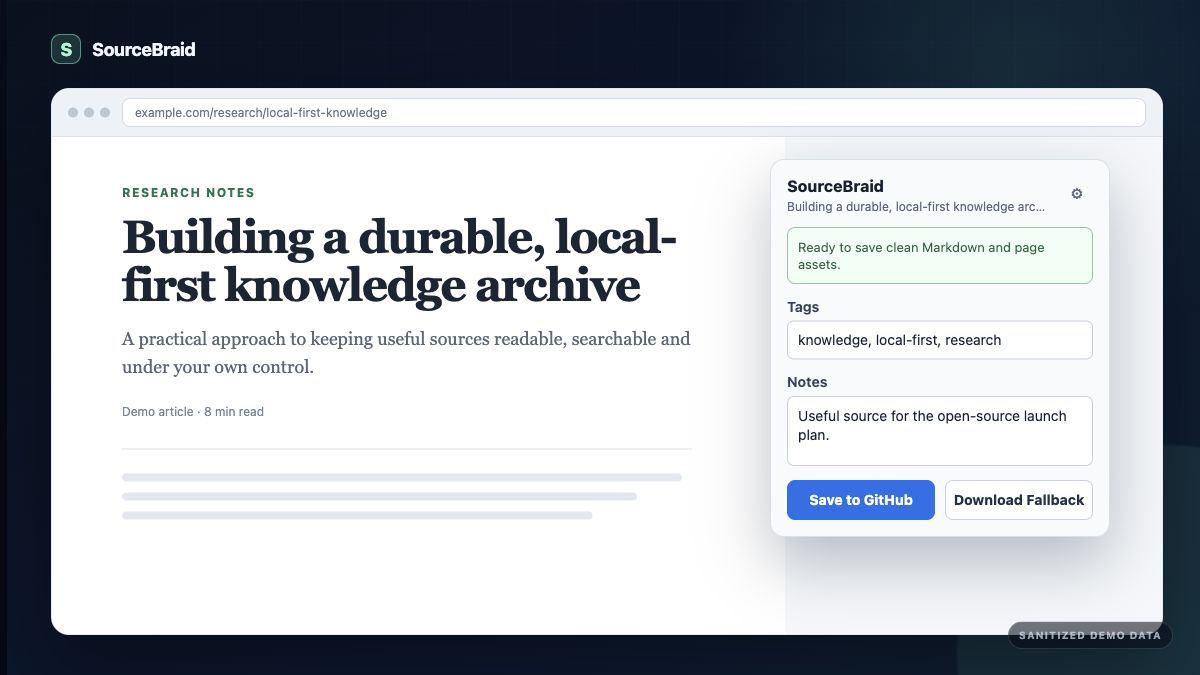
Capture with context
Save the source, your notes, and useful tags in one deliberate action.
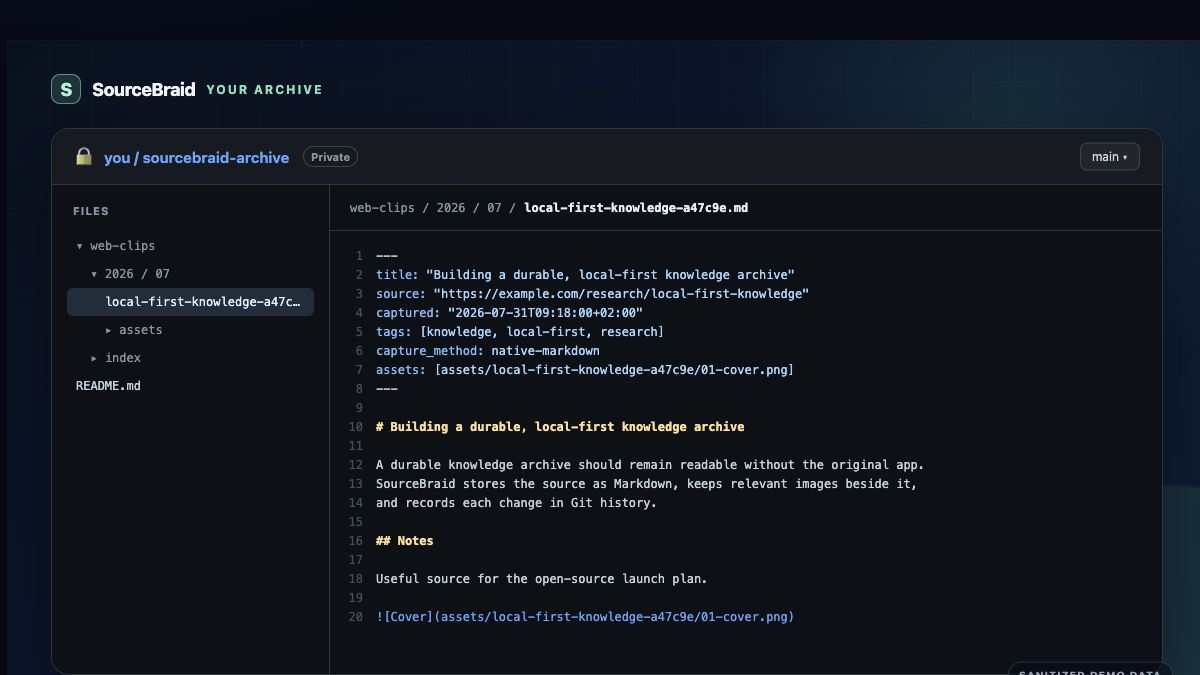
Own the durable result
Plain Markdown, local assets, metadata, and Git history remain readable without SourceBraid.
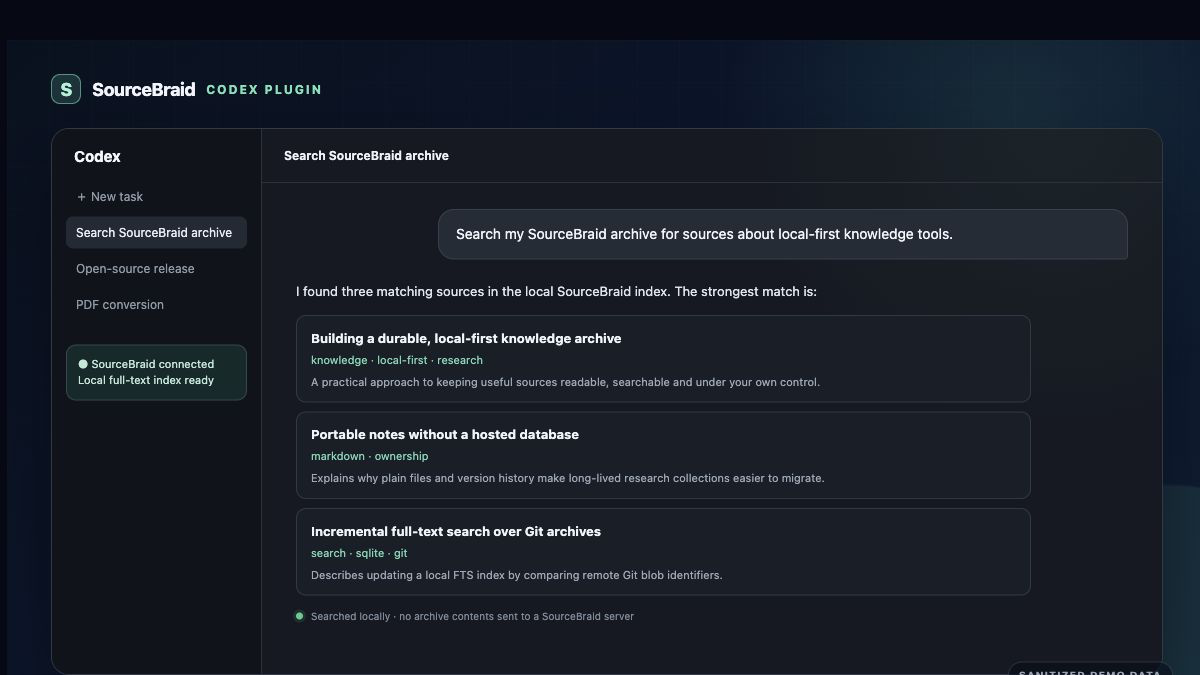
Retrieve with evidence
Search from ChatGPT or Codex and retain the canonical source URL for citations.
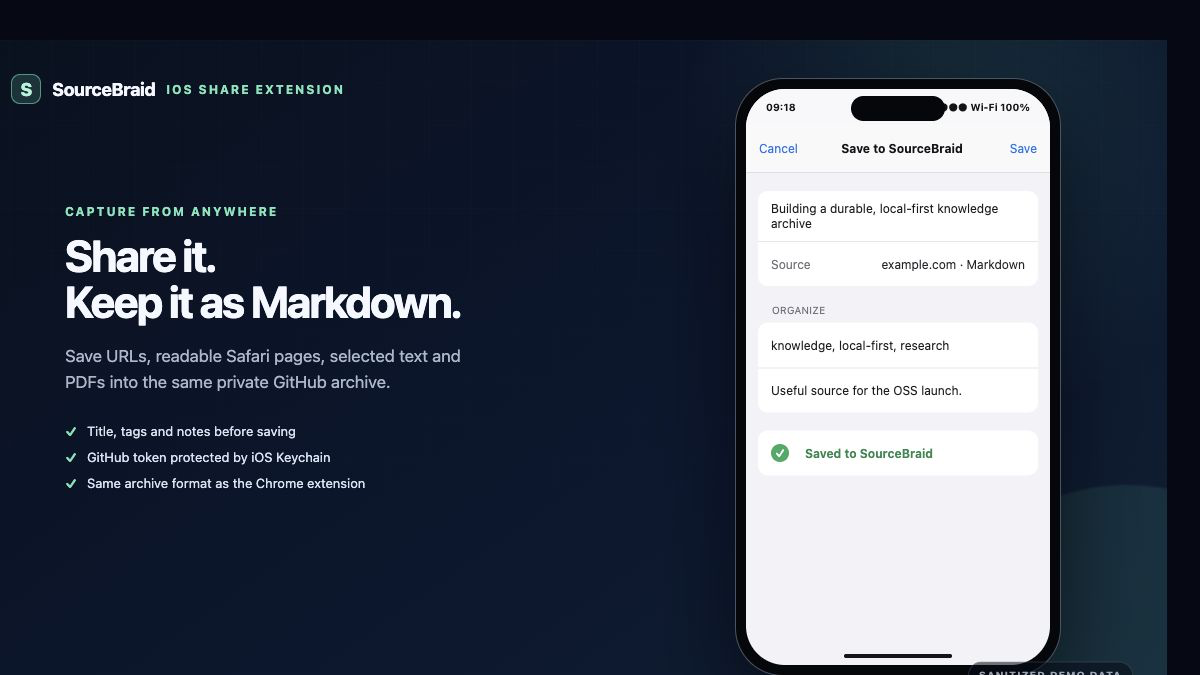
Capture from iOS
Use the familiar share sheet to keep research flowing into the same archive.
MIT licensed
Built in the open. Owned in private.
The Chrome extension, iOS app, GitHub workflows, extraction logic, and ChatGPT/Codex plugin are published together. Test a source, improve an adapter, or help shape Android support.
Questions, answered
Before you start weaving.
Does SourceBraid host my archive?
No. Capture clients write directly to the private GitHub repository you configure. The project does not operate a central content service.
Why not keep ordinary bookmarks?
Bookmarks depend on the source staying available and searchable. SourceBraid keeps a readable Markdown representation, provenance, metadata, and relevant assets under your control.
How are PDFs handled?
The original PDF is committed first. A GitHub Action uses Docling to produce Markdown, OCR text, tables, and figures while retaining the source file beside the result.
Is Android supported?
Not in the first release. The Android share target is intentionally waiting for community feedback so effort follows real demand.
Keep the useful web